I´m sitting in a House of Echo Chambers
In recording technology (at Bell Labs or Abbey Road Studios from the 1930s onwards, for example), an “echo chamber” is a purpose-built reverberation room: a signal is played into the room through a loudspeaker, picked up again by a microphone, and mixed back into the original signal. This is exactly the mechanism Alvin Lucier uses in I am sitting in a room (1969). With it, he literally turns the room into an echo chamber that is passed through again and again. He does not use the process once to create a reverb effect, though. He repeats it recursively until the signal has been completely consumed by the sound of the room.
In the political and media sense, an “echo chamber” is a discourse that reinforces itself through repetition among like-minded people, with no outside input (cf. the filter bubble). Through ongoing self-reference, the content is lost and replaced by mere resonance: the amplification of the same thing over and over.
The title i’m sitting in a house of echochambers plays on this double meaning: six spaces of discourse, in each of which individual quotations and positions are transformed by their own principle of sonic repetition. The reverberation of acoustic feedback becomes a metaphor for discursive self-reinforcement. Lucier uses the room in the technical sense of a studio echo chamber (a loudspeaker–microphone loop), yet produces no echo in the strict sense. Brachtel’s work, by contrast, deliberately engages with the media meaning of the echo chamber. In doing so, it goes beyond Lucier’s loss of verbal content semantically rather than acoustically.
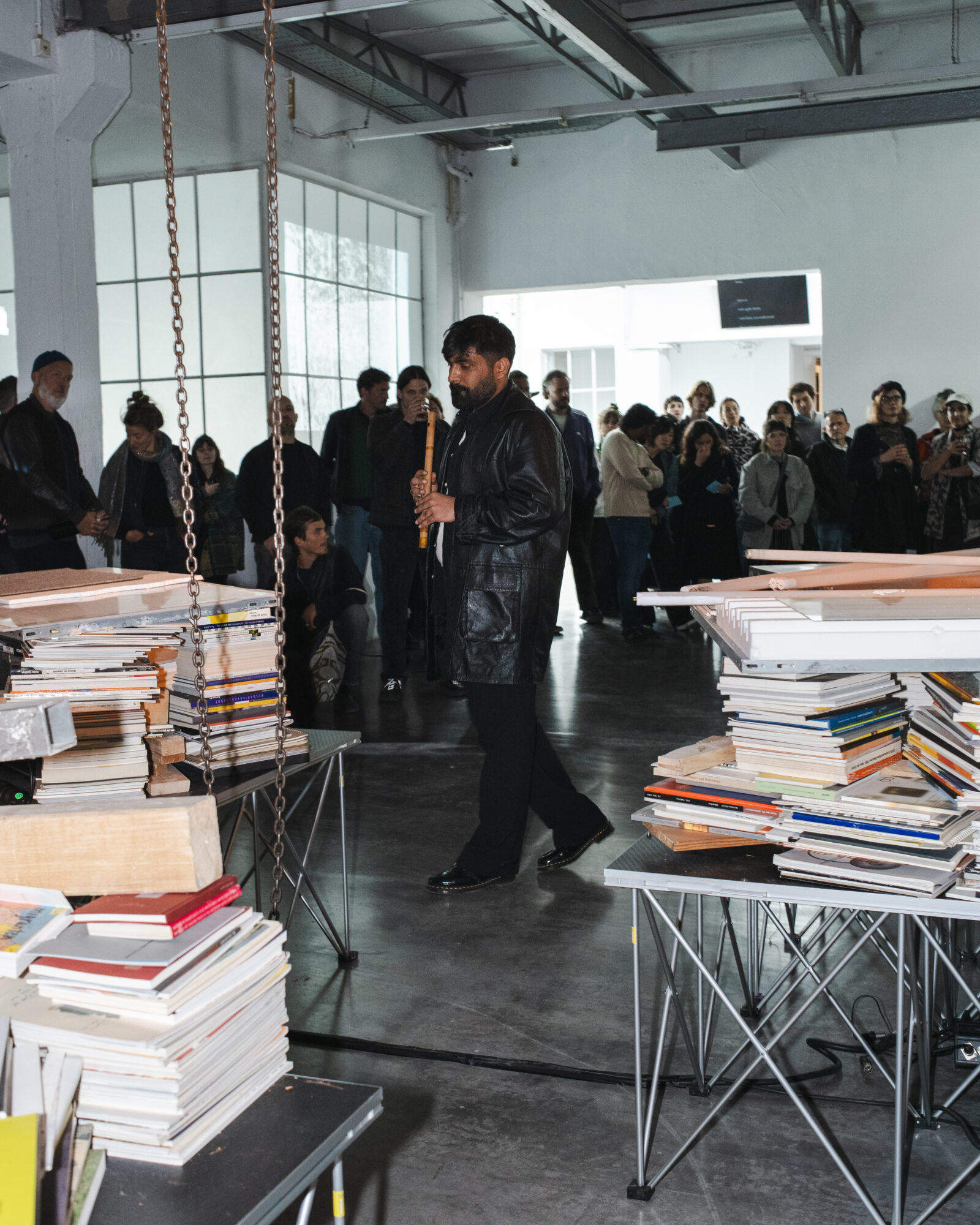
To counter the dogma of self-reference, Brachtel invited bansuri player Himansh Pandey to enter into communication with the activated room modes. A mediator between dimensions, the flautist communicates with the standing waves of the basement not through language but through breath. The bansuri, itself nothing more than a hollow length of bamboo, lives solely on the player’s continuous breath. The room modes of the six chambers are not events either but enduring states: standing waves that are not played, only excited and sustained.
Two forms of the same principle meet here: human breath, and architecture as a carrier of tones. Pandey’s playing seeks out the basement’s resonant frequencies in order to join with them, until it becomes unclear whether the flute is making the room sound or the room the flute. This ambiguity is what interests Brachtel: neither system is sufficient unto itself. Breath alone would be mere air, the room alone mere silence. Only when they meet does a sound emerge that neither could reach on its own.
The Exhibition is open daily from Sept 25th until December 13th 2026.